
What Is the Minimum Order for Private Label Supplements?
Typical minimums, what sets them, what a first run costs, and how to tell whether a low minimum is a good deal.
It depends on the format, the formula and the manufacturer. At halo PRIVATE LABEL, stick pack orders on our stock formulas start at 15,000 sticks, and most first launches sit between 25,000 and 50,000 sticks: enough to test real demand without tying up cash in inventory. Custom formulas are quoted case by case. A low minimum only helps if the small run gets the same testing, batch records and label review as a large one.
“What's the minimum order?” is usually the first question brands ask when they look into private label supplements. It is a fair question, because it tells you what your budget can buy. But comparing manufacturers on the minimum alone leads many brands to the wrong partner. This article covers what minimums usually are, what drives them, what a first run costs, and what to check before you accept a low number.
Key takeaways
Minimums vary by format
For stick packs, halo's stock formulas start at 15,000 sticks and a typical proof-of-concept run is 25,000 to 50,000.
Fixed costs set the floor
The minimum is set by line setup, packaging print runs and the fixed compliance work every batch needs.
No exemption for small runs
FDA's manufacturing rules apply to every batch. There is no exemption for small or pilot runs.
$15,000 to $25,000 all-in
A focused first launch typically costs $15,000 to $25,000 all-in in our experience.
Judge the small run, not the number
Judge a manufacturer by what it does on a small run, not only by how small the run can be.
What is the minimum order for private label supplements?
There is no industry-wide number. Each manufacturer sets its own minimum based on its equipment, its packaging suppliers and how it prices setup work. For powdered stick packs, halo PRIVATE LABEL's minimum is 15,000 sticks on stock formulas, as listed in our FAQ. Custom formulas have their own minimums because they need new raw materials, specifications and testing.
The minimum and the right first order are not the same thing. For most first launches, we recommend 25,000 to 50,000 sticks, a range we explain in The Question Every Supplement Founder Gets Wrong.
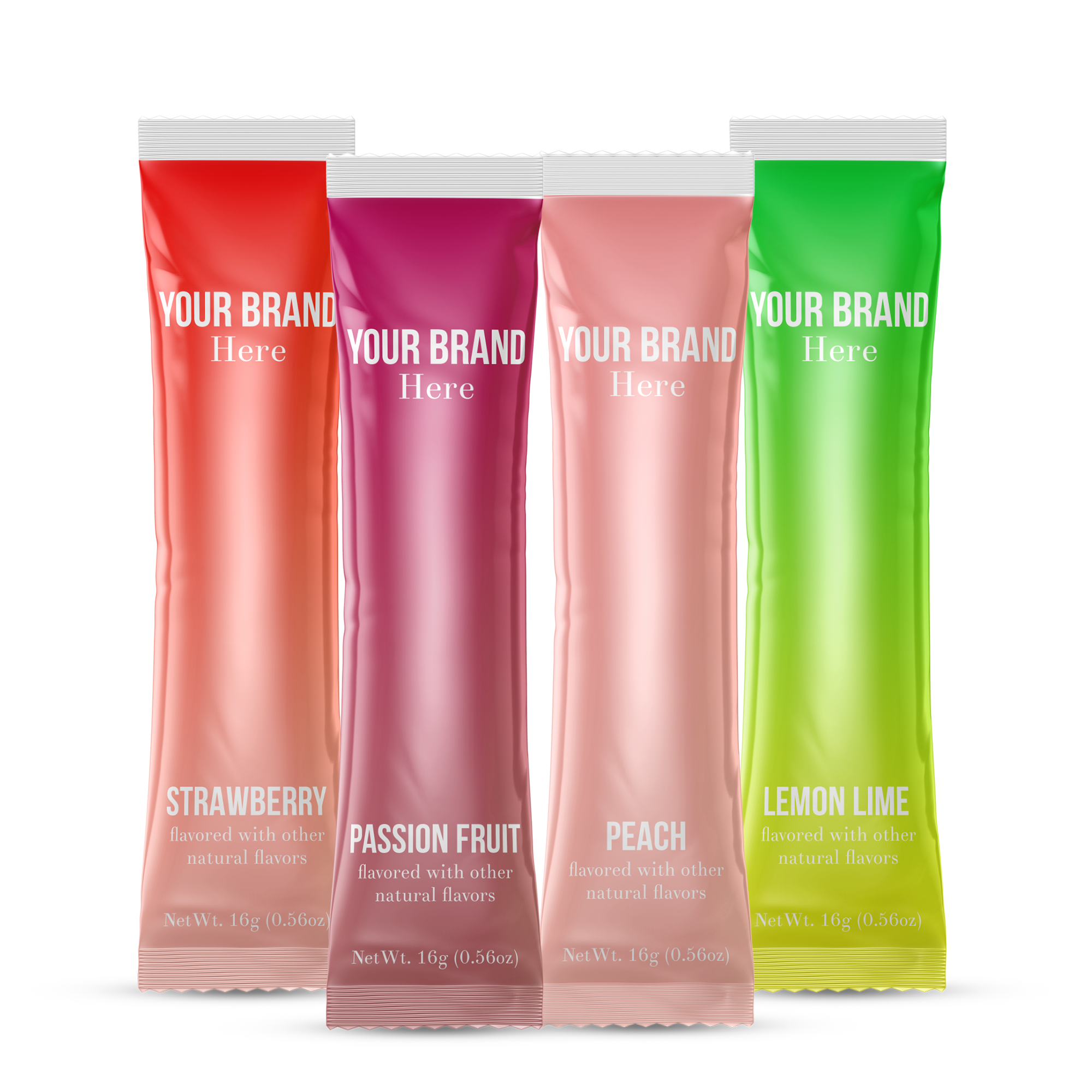
Size the first order to what you can realistically sell in about 90 days.
What sets a manufacturer's minimum order
| Factor | Why it affects the minimum |
|---|---|
| Fill format | Stick packs, pouches, tubs and capsules run on different lines. Each has its own setup cost and a point below which a run stops making economic sense. |
| Line setup and changeover | Every new SKU needs the line set up, calibrated and cleaned. That cost is the same whether you fill 15,000 sticks or 150,000. |
| Stock vs. custom formula | Stock formulas use raw materials the manufacturer already holds. A custom formula needs new ingredients bought in, often with their own supplier minimums. |
| Printed packaging | Stick film, pouches and cartons are printed in runs with their own minimums. Some manufacturers make you buy these yourself; others buy across their client base. |
| Fixed compliance work | Batch records, testing and label checks cost roughly the same per batch, whatever the batch size. |
Why is the lowest minimum not always the best deal?
Most buyers treat the minimum like a ticket price: find the lowest one and you have found the easiest way in. In contract manufacturing, two things make that comparison misleading.
A small minimum can hide what was left out
If a manufacturer offers a very low minimum by skipping testing, label review or proper records, those gaps follow the product into every reorder. They tend to surface at the worst time, such as when a retail buyer or distributor asks for documentation.
Per-unit price and total cost point in opposite directions
A larger minimum always shows a cheaper price per stick, because setup costs spread across more units. That does not make it the cheaper order.
Illustrative comparison from What It Really Costs to Launch a Supplement Brand.
What compliance work does every batch need, regardless of size?
The FDA's Current Good Manufacturing Practice rules for dietary supplements (21 CFR Part 111) apply to every batch. There is no exemption for a small first run. Among other things, they require:
The rules do not require an independent third-party lab. A manufacturer can test in-house, and it can verify specifications on a statistically selected subset of batches rather than every one. Many brands still ask for a certificate of analysis (COA) on every run, and independent testing is widely seen as good practice. Ask each manufacturer exactly what testing your run gets and who does it.
Label claims follow their own rules
A structure/function claim such as “supports hydration” does not need FDA approval, but it must be substantiated, it needs the standard FDA disclaimer on the label, and FDA must be notified within 30 days of first marketing the product (21 CFR 101.93). None of this changes with order size.
A small run doesn't shift responsibility to the manufacturer
Under FDA rules, the brand named on the label is responsible for making sure the product meets these requirements, even when manufacturing is contracted out. We cover this in more detail in Private Label vs. Custom Formulation.
How much does a first private label run cost?
In our quoting experience, a focused first stick-pack launch typically lands around $15,000 to $25,000 all-in. That covers formulation work, the first production run, packaging, testing and launch compliance. It is large enough to generate real sales data and stock a first channel, without a large bet before you have proof of demand.
In our experience, the timeline from brief to first run is typically 8 to 10 weeks. That covers formula confirmation, artwork and label review, production scheduling, manufacturing, testing and shipping preparation.
Production is only part of the budget. Our rule of thumb is that whatever you spend to launch, you should plan a total of about five times that for your first six months, with most of the difference going to customer acquisition, sampling and trial. The full breakdown is in What It Really Costs to Launch a Supplement Brand.
What should a first order prove?
A first private label order does more than fill a shelf. It should tell you four things:
Not “what is the smallest order I can place?” but “what is the smallest order that gives me enough stock to learn from and enough documentation to support my next step?”
That next step might be a reorder, a new SKU or a pitch to a retailer.
How to judge a manufacturer by its minimum order
Experienced brand builders use minimum order policies as a filter, not a price tag. Look for a manufacturer that meets these four tests:
It runs small batches with the full process
Batch records, specification testing and label review happen on a first run exactly as they do on a large reorder.
It can explain its minimum
A clear answer in terms of line setup, packaging and testing costs is a good sign. A number with no explanation is harder to trust.
It helps you size the first order
A good partner will sometimes recommend ordering less than you planned. One that only pushes for more is protecting its own economics.
Its service does not drop on small orders
Formulation meetings, artwork review and label compliance support should be the same on a first run as on a large one.
Questions to ask about any minimum order quote
- What exactly is included at your minimum: formula, packaging, artwork, testing, label review?
- What testing does each batch get, who performs it, and will I receive a COA?
- Will I get a copy of the batch record?
- Who buys the stick film and outer packaging, and are there separate print minimums?
For a full checklist, see What Should I Look for in a Supplement Manufacturer?
If a manufacturer passes these tests, the exact minimum becomes a secondary detail. What matters more is whether it handles your first batch the way you want your brand represented.
How halo PRIVATE LABEL handles first runs
halo PRIVATE LABEL sets minimums for proof-of-concept launches, starting at 15,000 sticks on stock formulas. Every run, including the first, goes through the same process: batch records, a COA for the finished product, label review and a single point of contact from brief to delivery. We buy stick film and packaging across our client base, so you are not left sourcing print runs on your own. See the full process on our How It Works page and the packaging options on Formats.
Our minimums also suit smaller programs, such as branded electrolyte sticks for trade shows and events.
Frequently asked questions
What is the minimum order for private label supplements?
Why do supplement manufacturers have minimum order quantities?
Is a lower minimum order always better?
How much does a first private label supplement order cost?
How long does a first private label run take?
Do FDA rules apply to small supplement production runs?
Does every supplement batch need a third-party certificate of analysis?
How should I decide how many units to order first?
Planning your first run?
Tell us what you want to launch and where you plan to sell it, and we will recommend a first order size and give you one all-in number. Request a quote, or order a sample kit to try our stock formulas first.
Sources & Verification
Minimum order, cost and timeline figures are based on halo PRIVATE LABEL's production and quoting experience, 2025 to 2026, and vary by formula, packaging format, volume and market. The per-stick comparison is illustrative.
Regulatory references:
- FDA: Dietary Supplements overview
- 21 CFR Part 111: cGMP for dietary supplements
- 21 CFR 111.75: verifying that specifications are met
- 21 CFR 111.255: batch production record
- 21 CFR 111.83: reserve samples
- 21 CFR 101.93: structure/function statements, notification and disclaimer
- Natural Products Insider: FDA's position on own-label distributors and contract manufacturers